
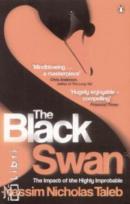
by Nassim Nicholas Taleb
One of these books, which apparently everybody has to read. Normally I avoid them but the mathematical touch of the topic drew me into it. And in fact I cannot agree more with the central claim that pure luck changes one’s “faith”, or that of a society, or for that matter a social entity. The social aspect of the system in the context of luck is important to understand, since human behavior is not really predictable. In turn the economy is driven by human behavior -and luck; not by natural laws as many want to make us believe. Illustrative examples in the finance area play a major role throughout the book. Not very surprising when you consider the author’s background: he made his fortune as a broker with the financial crises in 1987. One claim is repeated like a mantra in ever-changing alterations: unpredictable or unexpected events change the course of our life – let it be the economy, technology, sales numbers of a book or your own private life. These so-called unexpected events change the scenarios much more then working to a predefined goal within known (predicted) boundaries.
One aspect of the book is very often misunderstood since he is so vocal about it. The Gaussian bell curve abuse is constantly attacked by him. The Gaussian bell curve is an expression of the statistical probability than a certain event will occur. By chance! But there are two types of chance (luck): the unpredictable chance, which prevails in social interaction and the chance a measurement error occurs. The latter is predictable (quantifiable) with statistical methods based on the bell curve. of the other type of chance you can be only aware, you cannot predict it. But many economic models base their predictions on the Gaussian bell curve (actually on some statistical distribution of this kind). That is the point Taleb is ferociously fighting against.
The book might not be well written, sometimes it is tiring to read the repetition of one point. But the content weighs that weakness out. By far!
One aspect of the book is very often misunderstood since he is so vocal about it. The Gaussian bell curve abuse is constantly attacked by him. The Gaussian bell curve is an expression of the statistical probability than a certain event will occur. By chance! But there are two types of chance (luck): the unpredictable chance, which prevails in social interaction and the chance a measurement error occurs. The latter is predictable (quantifiable) with statistical methods based on the bell curve. of the other type of chance you can be only aware, you cannot predict it. But many economic models base their predictions on the Gaussian bell curve (actually on some statistical distribution of this kind). That is the point Taleb is ferociously fighting against.
The book might not be well written, sometimes it is tiring to read the repetition of one point. But the content weighs that weakness out. By far!
Facts:
English title: The Black Swan
Original title: The Black Swan
Published: 2007
